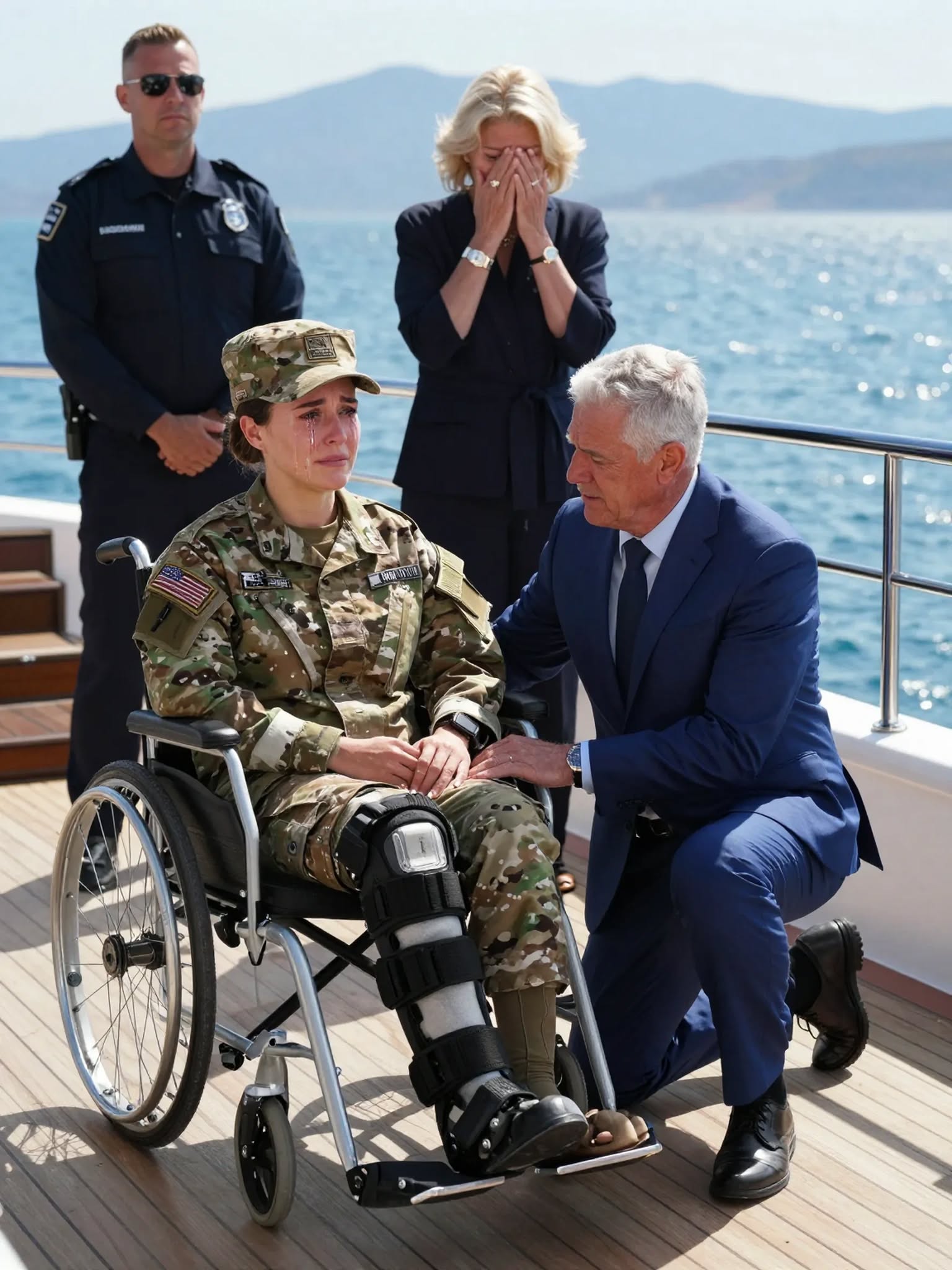
My father looked at my wheelchair, took a drink of beer, and told me to go to the VA because he “didn’t have space for cripples” in the house I had secretly paid off for him. Three days later, while he threw a party celebrating the mortgage being gone, the bank called on speaker and announced the truth: I was the new owner, and he had one hour to get out.
My father looked at my wheelchair, took a drink of beer, and told me to go to the VA because he “didn’t have space for cripples” in the house I had secretly paid off for him. Three days later, while he threw a party celebrating the mortgage being gone, the bank called on speaker and announced the truth: I was the new owner, and he had one hour to get out. Part 1 My name is Ethan Miller. I was thirty-two years old the afternoon my father shut the front door in my face, and if you had told me even a month earlier that I would survive a war overseas only to be turned away from my own family home like a trespasser, I would have called you cruel. The first thing my father said to me was not welcome home. It was, “We don’t run a nursing home.” He stood in the doorway with a can of cheap beer in one hand, his broad frame filling the entrance like a barricade. He wore the same old red flannel shirts he had favored my entire childhood, the same worn work boots, the same expression that always managed to combine irritation with self-pity, as though other people’s needs were personal attacks on his comfort. Rain had begun to fall, a gray Ohio drizzle that turned the driveway slick and dark, and behind me the taxi idled at the curb, its exhaust drifting low across the street. I had wheeled myself all the way up the driveway already, my palms stinging from the rims, my shoulders burning from the grade of the incline. It was the same driveway I used to shovel as a kid every winter before school, back when my legs worked and my biggest problem was algebra. Now, I sat in dress blues, medals polished and perfectly placed, the fabric stiff and formal against a body that still had not fully learned its own new geometry. My chair stood on the porch boards I had paid to refinish three summers ago. The house behind him smelled exactly the same even from the threshold—lemon polish, stale smoke, old carpet, and something fried in too much oil. For a single, humiliating second, some part of me had expected a banner, or a hug, or even the awkward stiffness of a family trying and failing to be loving. Instead my father looked only at the place where my legs used to be. His gaze lingered there, his face tightening not with grief, not with pity, but with inconvenience. “Go to the VA,” he said. “We don’t have room for cripples.” He did not know that the roof over his head and the floors under his boots had been paid for by the deployment money, reenlistment bonuses, disability backpay, and injury settlement I had spent years funneling home while he complained about mortgage payments and played the martyr in his own kitchen. “Dad, it’s me,” I said, forcing my voice to stay steady through the phantom pain that had started up in the missing left calf like live wires under skin that no longer existed. “I’m back. I tried calling, but—” He took a swallow of beer and leaned harder into the frame. “I see that. I see the chair. And I already told your mother I’m not turning this place into a facility.” “People like me?” I asked when he said the VA had beds for people like me. My voice shook, but not from fear. It was shock and nausea and something darker beginning to rise underneath both. “I’m your son.” “You’re a burden,” he said, with the flat practicality men like him mistake for honesty. “I’m not changing diapers at my age. We finally got this place how we want it. Turn around and go somewhere else.” The cruelty was not theatrical. That was what made it worse. He spoke about me the way a man talks about a busted washing machine—regretful only insofar as something broken might become expensive. I looked past him into the hallway. There was a welcome-home sign taped to the mirror, and for half a heartbeat my chest leapt before I saw the dog bed beneath it and understood. It wasn’t for me. Chloe’s new puppy was getting the celebration. Then my sister appeared behind him, twenty-two and glossy and beautiful in the high-maintenance way that required money, time, and the firm belief that the world should organize itself around her convenience. She had an iced coffee in one hand and disdain already arranged across her face. She looked at the chair, then at me, and wrinkled her nose. “Seriously?” she said, laughing. “I literally just redid your room. I turned it into a walk-in closet for my shoes. The lighting is amazing. Where were you planning to sleep? The hallway?” For a second I thought I must have heard her wrong. My room. The room with my old baseball trophies, the model planes, the cheap desk where I’d filled out my enlistment paperwork at seventeen and kept it hidden from Dad for three days because I knew he’d say I was doing it for attention. “My room?” I repeated. “Well, you weren’t using it,” she said, inspecting her nails like we were discussing throw pillows. “And honestly, those wheels are going to destroy the hardwood.” Before I could answer, something small shot between my father and the frame. Leo. My ten-year-old brother. Skinny, bright-eyed, clutching the faded superhero blanket I had mailed him from Germany because he once told me over video chat that it helped him sleep when thunderstorms came through. “Ethan!” he shouted, his whole face lighting up with a kind of love adults often lose the ability to feel cleanly. He started for me, but Dad caught him by the back of the shirt and yanked him hard enough to make the kid stumble. “He can stay with me!” Leo yelled, fighting against his grip. “I have a bunk bed! He can take the top!” Chloe snorted. “He can’t climb to the top, idiot.” “Then he can have the bottom!” Leo shouted, tears already gathering. “I’ll sleep on the floor! Please, Dad!” “Enough!” My father slammed his hand against the doorframe. The glass rattled. “You’re embarrassing us. Get off the porch, Ethan. Go to the motel on Route 9. We’ll talk next week. Maybe.” Then he stepped back. He looked at me once more, not with regret, not even with real anger—just the expression of a man annoyed that a problem had shown up in person. Then he shut the door. The lock clicked with a heavy metallic finality that rang in the wet air like a gunshot. I sat there in the rain for a few seconds after he closed it. Water ran down the back of my neck and soaked the collar of my uniform. I looked at the door I had sanded and repainted for him three summers earlier. I looked at the flowerbeds I had paid to have professionally landscaped because Mom once said she missed having something pretty to look at when Dad came home drunk and loud. I looked down at the folded bank letter in the inside pocket of my jacket—the surprise I had carried all the way home from Germany. I had planned to put it on the dinner table that night and say the mortgage was gone, that the house was theirs free and clear, that Frank Miller could finally retire from blaming the world for the life he built badly. Instead I touched the edge of the paper and felt it become something else in my mind. Not a gift. A weapon. I turned the chair around and rolled back down the driveway. The wheels hissed on wet concrete. By the time I got into the taxi, the driver had the kind of careful pity on his face people save for funerals and hospitals. “Where to, soldier?” he asked quietly. I folded the chair into the trunk with hands that shook from adrenaline and cold and said, “The motel on Route 9.” Then I pulled out my phone and added, “And pass me that phone book up front, would you? I need the number for the foreclosure department at First National.”