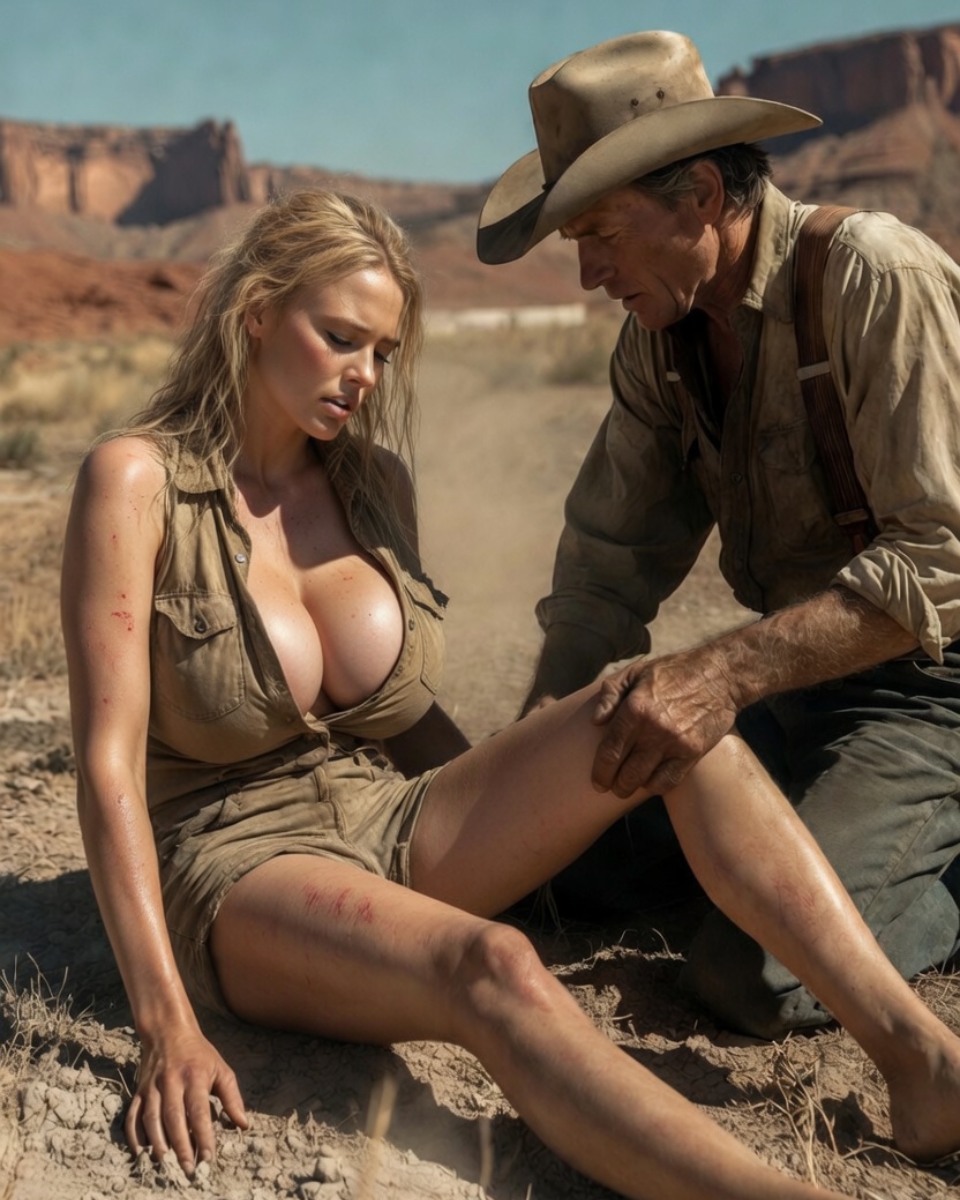
The heat was merciless, pressing down on the land until the cracked ground beneath it seemed to beg for mercy, and the very air shimmered like liquid fire under the midday sun.
Across that scorched expanse, a young woman staggered forward, hands bound in front of her, moving only because some stubborn, unyielding force within refused to let her collapse entirely.
The rope had bitten so deeply into her wrists that the skin was raw, red, and blistered, each step sending jolts of pain up her arms, yet she didn’t cry out.
Her breaths came in harsh, shallow gasps, the dusty air scraping her lungs, while the sun beat mercilessly down, threatening to sap every ounce of energy left in her body.
Ahead of her stood the ranch house, distant and ominous, its wooden structure trembling slightly in the heat, as if aware of the storm of fear and desperation approaching its doors.
Ethan Marshall, the rancher, watched from the porch, his face unreadable, his jaw clenched, the rifle resting across his lap, yet his eyes betrayed a conflict that no one else could see.
He had been here before, staring down impossible decisions, each choice heavier than the last, yet none had ever felt as stark, as final, as the one before him now.
The woman stopped briefly, swaying on her feet, sweat pouring down her face, her eyes meeting his across the open field, filled with a mixture of fear, defiance, and something that made him hesitate.
“Don’t untie me… just end it,” she whispered, voice raw but steady, a chilling resolve that caused the air around them to thrum with tension, threatening to snap at any moment.
Ethan’s hand tightened around the rifle, the weight of it suddenly unbearable, as memories of hardship, loss, and responsibility pressed down on him, reminding him that choices have consequences far beyond the immediate moment.
The town had whispered about him, rumors circulating about the rancher who lived by strict rules and harsher judgment, a man who could decide life and death with a glance, a reputation he had cultivated carefully.
But no reputation mattered now. He watched the sweat streak her dirt-stained face, the rope scars on her wrists, the stubborn glimmer in her eyes, and felt the terrible weight of responsibility pressing down like a boulder.
“You don’t understand,” he murmured, almost to himself, voice low, yet carried across the field in the searing heat. “This isn’t punishment. This… this is survival, trust, and judgment all rolled into one.”
She took a step closer, ignoring the pain, the sun, the blistering ground beneath her feet, because she understood that whatever happened now would decide everything about her life, and possibly, his conscience forever.
Ethan remembered the warnings of the neighboring ranchers, the murmurs of the town folk who believed in swift, decisive action, who had told him there was no room for mercy in the scorched lands they called home.

Yet standing there, watching her struggle, watching her human determination unfold in the heat, he realized that perhaps the harshest measure of a man was not cruelty, but the courage to act with conscience under impossible pressure.
The wind stirred slightly, carrying the dry scent of earth, grass, and something else—an unspoken tension that made every hair on his arms rise, every muscle taut with anticipation and fear of what decision would come next.
“Why?” she asked softly, voice trembling yet commanding, “Why even make me walk this far if it’s just to… to decide my fate? I’ve already suffered enough.”
Ethan swallowed hard, the rifle suddenly feeling heavier than ever, realizing that her endurance, her courage, and her plea had humanized the decision in a way that no logic or law could dictate.
“Because,” he replied slowly, carefully, “you wanted it your way. You demanded control over the final step. You asked me to judge, and I cannot ignore the strength it took to walk here yourself.”
She blinked, confusion and surprise mingling in her features, sweat glistening on her brow, the sun casting long shadows across the field that seemed to stretch into eternity.
“I… I didn’t mean to…” she began, voice breaking, but he raised a hand gently, halting her, signaling that she had already proven something no words could convey.
The townspeople, watching from afar, whispered and murmured, some in disbelief, others with curiosity, all captivated by the unfolding tension between human endurance and moral reckoning.
Ethan slowly lowered the rifle, not out of weakness, but understanding. He realized that this decision would define him, define her, and perhaps, even define the morality of their harsh, unforgiving land.
Her breathing steadied slightly, shoulders drooping as the tension released ever so slightly, the rope still biting, but her gaze softened as she sensed a shift in the wind, a shift in the inevitable judgment.
“Don’t make it about vengeance,” she said softly, “if you’re going to decide, decide with fairness. Decide with what’s right, not with what’s easy.”
The words struck him harder than any drought, any loss, any judgment he had faced before. He realized that life in the scorched lands was about more than survival—it was about empathy, courage, and knowing when to act with justice.
Minutes stretched, the silence only broken by the faint rustle of grass, the distant cry of cattle, and the slow, deliberate rhythm of his heartbeat echoing in his ears, reminding him of the gravity of the moment.
He stepped forward slowly, each movement deliberate, conscious of the eyes on him, the weight of the rope, and the trust—or perhaps defiance—she had placed in his hands.
Her knees wobbled slightly, yet she refused to fall, her chin lifted, meeting his eyes with a mixture of fear, challenge, and unspoken understanding, the kind that binds two people in the crucible of life and death decisions.
Ethan felt something shift inside him, the heat, the dryness, the sun-scorched earth around them all fading into insignificance compared to the raw human struggle standing before him.

“I…” he began, his voice steady but low, “I cannot undo what you’ve endured, nor will I ignore the strength it took to reach this point. But I also cannot act in haste, in anger, or without conscience.”
The rope burned against her wrists, yet she remained silent, listening, her breathing slow, almost ritualistic, as if each inhale and exhale were part of an unspoken negotiation of fate.
The sun dipped slightly, painting the sky with amber and gold, casting long, dramatic shadows across their faces, reflecting the gravity and consequence of the moment in every crevice and line.
Ethan dropped the rifle entirely, kneeling slowly, placing his hands lightly on hers without untying them, and said, “You’ve survived, endured, and demanded justice in your own way. That is not weakness—it is strength, and I will not ignore it.”
Her eyes widened, a mixture of relief and disbelief washing over her face, realizing that the rancher, the man with power over life and death on this scorched land, had chosen mercy and recognition instead of cruelty.
The townspeople began to murmur louder, recognizing the rare display of empathy and moral courage in a place where judgment and harshness were often the norm, where survival sometimes trumped morality.
Hours later, she finally collapsed to the ground, exhausted but alive, her wrists still marked by the rope, her spirit unbroken, and Ethan sat beside her, reflecting on how one decision could shift lives, communities, and the morality of a harsh land.
In that moment, he realized the truth: survival was not only about endurance, cattle, or the scorched earth, but about knowing when to act with heart, conscience, and respect for the resilience of another human being.